Anything after Democracy?

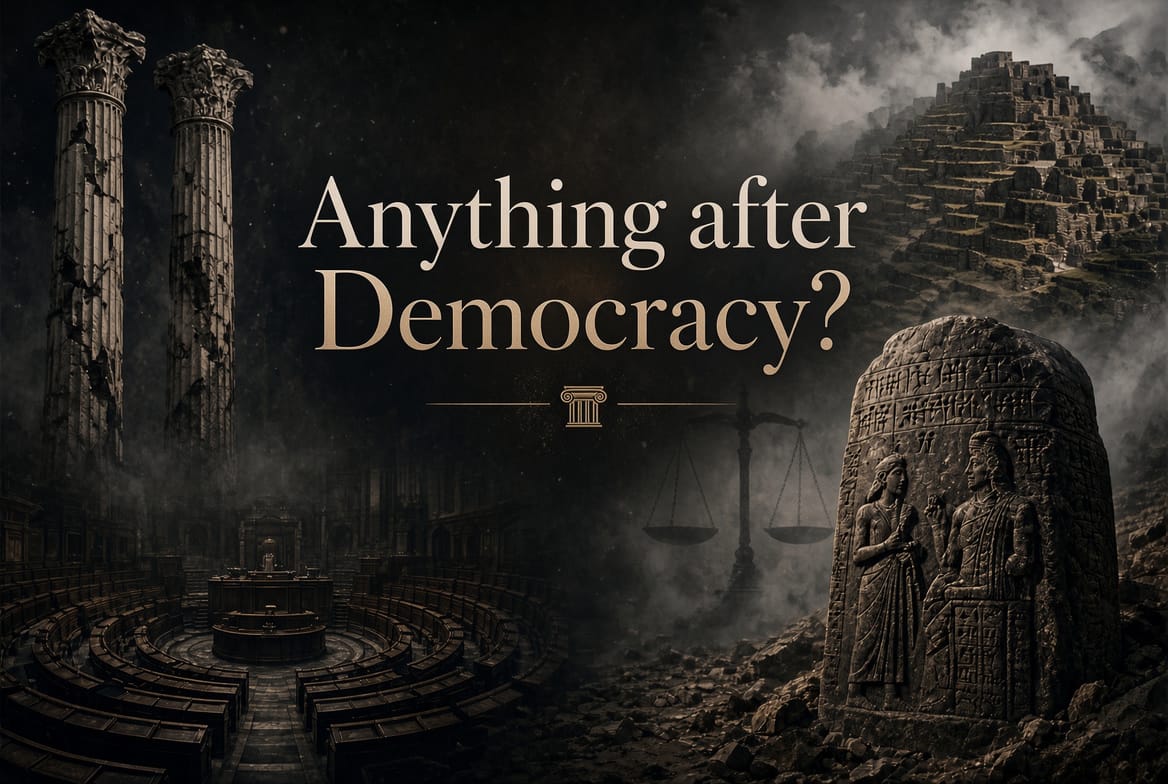
History's shift from nomadic hunter-gatherer life to settled agriculture created surplus, specialization, and scale. With scale came hierarchy in owning resources and managing them. Early law codes, including Hammurabi’s famous code, were attempts to stabilize increasingly large and unequal societies by tying the ruler’s legitimacy to their public claim of justice. Religion then extended the code and satisfied the supernatural instinct of humans by bridging the cosmic gap with heavenly writs. The earthly effect was the predictability of written rules. The publicly stated goal was that the strong should not devour the weak without limit. That goal was real but incomplete as Nietzsche laid painfully bare. The same religions and codes legitimized natural hierarchies as status distinctions and treated persons of different ranks differently. Some surviving cultures with prehistoric origins still practice these distinctions overtly while others professed absolute equality but pushed the attainment of justice to the afterlife. In any case, they left the sovereign’s monopoly on violence practically unchecked. The reciprocal guarantee of security in the contract rested on whim and luck.
Similar even in Isolated Evolution across Oceans
The same sequence unfolded independently in the Americas, far outside the Mesopotamian or Eurasian sphere. After the development of maize, potato, and other staple agricultures, societies from the Andes to Mesoamerica and the Mississippi Valley produced surplus, dense populations, and ranked societies. The Inca state organized labour, stored and redistributed goods, built roads and administrative centers, and presented the Sapa Inca as a divine intermediary whose rule guaranteed cosmic and social order. Aztec and Maya city-states likewise combined and codified priesthood, kingship, tribute, custom, and public ritual. In each case the stated purpose included fairness, reciprocity, and protection against famine, insecurity or chaos. And in each case the reality included rigid hierarchy, forced relocation, harsh corporal and capital punishment. If that were not enough, several societies condoned large-scale ritual killing. Isolation did not result in a gentler path or better justice. Once agriculture made concentrated power possible, the incentives of rulers changed. The need to reward specialists in violence (armies), and the difficulty of monitoring distant officials generated despotism and uneven justice not much different on this side of the oceans.
Despotism did not require a sudden moral collapse. It followed from incentives that appear whenever power is concentrated and hard to monitor. Rulers face short time-horizons, succession crises, and the need to reward armed workers (armies). Information is scarce and local officials extract rents based on their authorities, and rivals must be pre-empted. Torture and arbitrary punishment are cheap tools of deterrence and extraction when thin-skinned rulers cannot reliably distinguish guilt from disloyalty. Once a state can field standing forces and collect taxes at a distance, the original bargain—order in exchange for restraint—tilts toward predation. Unless, of course, countervailing forces exist. Unfairness is therefore not an aberration from the early human legal quest. Rather, it is the default outcome when the experiment lacks independent enforcement.
The Transient Success of Liberal Democracy
Liberal democracy is one historically successful attempt to change the default. It multiplies veto points, subjects officials to regular replacement, protects exit and speech, and treats certain claims as rights rather than grants. It worked unusually well in a cluster of societies that already possessed high social trust, commercial habits, literacy, and a tradition of limited government. Those conditions were not universal, and prosperity made the system easier to sustain. Where the cultural and institutional preparations are thin, elections can become winner-take-all contests over the state’s extractive machinery rather than real constraints.
Other options exist and have been tried. Constitutional monarchy and hybrid regimes can separate the symbolic from the administrative and reduce succession violence. Federalism and genuine local autonomy shrink the prize of capturing the center, or the capital of the state. Independent courts, property rights, and open trade raise the cost of predation even without full electoral democracy. Sortition, rotation in office, and multi-centric legal orders (historical merchant law, some religious legal systems) attempt to dilute concentrated power without relying solely on mass voting. East Asian developmental states combined meritocratic bureaucracy with limited political contest and did deliver material growth, albeit at the expense of narrower political liberty. None of these is a universal solution. Each trades one failure mode for another: capture by elites, rigidity, corruption, or suppression of dissent.
Technology Limits for the Majority
The practical problem remains the same as in Hammurabi’s time: how to bind the people who hold the instruments of coercion. No single formula travels across time, cultures and geographies. Durable constraints usually combine formal rules with informal norms of restraint. Examples of these invisible tethers are economic interdependence that makes predation costly, and the possibility of exit via emigration or secession, or simply ignoring distant orders. Technology can hurt as it can lower monitoring costs and enable more thorough surveillance. We may be at a point where the Big Brother state may be inevitable for most of humanity. Culture is not infinitely plastic and not frozen and the repeated lesson is modest: power will be allocated unevenly. The question is whether the allocation can be made contestable, temporary, and expensive to abuse. That is a narrower and more portable goal than working towards any particular constitutional replacement for democracy.